





Which 2026 Ram Commercial Vehicles Qualify for Section 179?
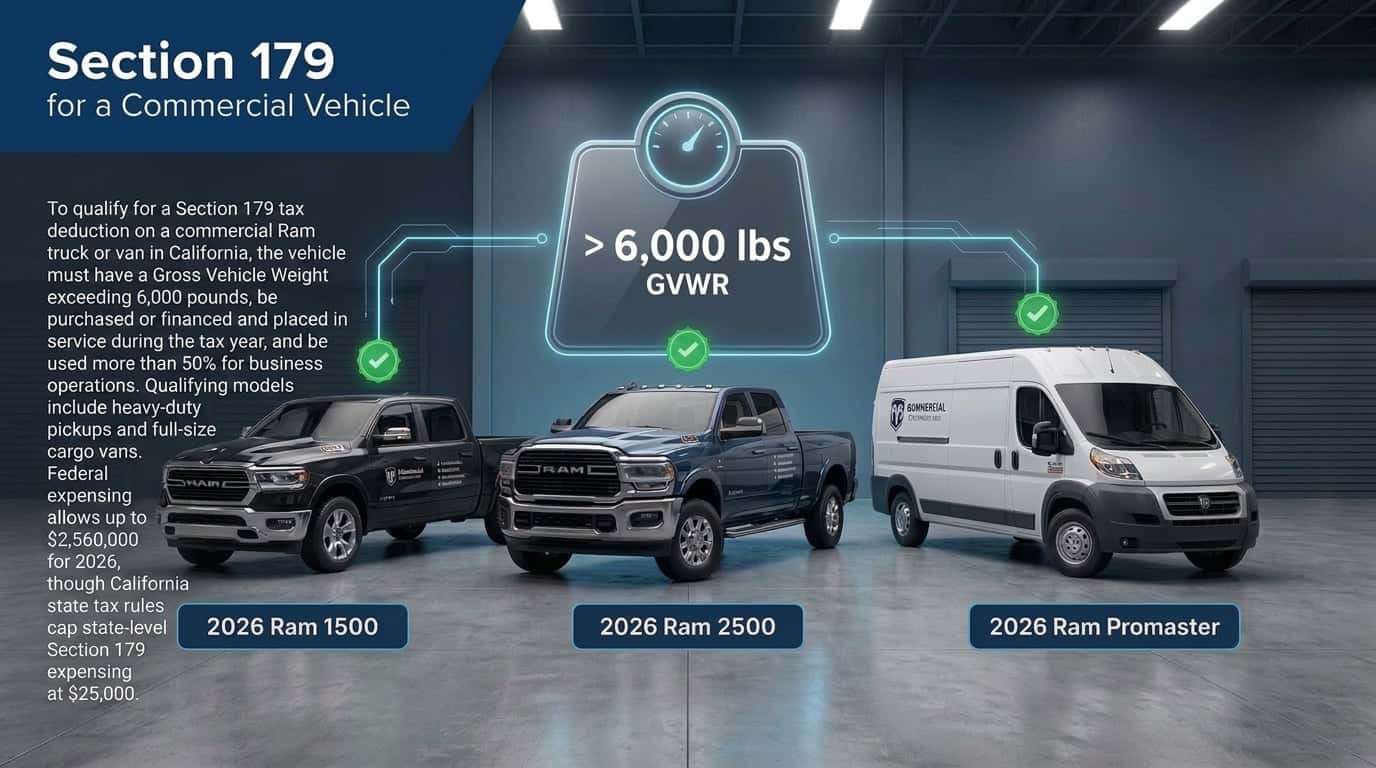
Every 2026 Ram 1500, Ram 2500, Ram 3500, and Ram ProMaster cargo van carries a Gross Vehicle Weight Rating (GVWR) above 6,000 pounds, making the entire commercial lineup eligible for Section 179 tax write-offs when placed in service and driven more than 50% for business.
Commercial buyers can take advantage of these federal tax write-offs across versatile light-duty pickups like the 2026 RAM 1500 Tradesman, heavy-duty workhorses like the 2026 RAM 2500 Tradesman, and spacious cargo haulers like the 2026 RAM ProMaster 1500. Business owners in San Jose operating across tech infrastructure support and commercial trade routes rely on these official weight ratings to lower their net tax liability while expanding company fleets. To examine safety compliance labels in person, visit our commercial showroom at 39639 Balentine Dr in Newark or give our sales team a quick call at (510) 257-9176.
Table of Contents
- What GVWR Thresholds and IRS Rules Determine Full Section 179 Tax Deductions?
- Does Every Trim of the 2026 Ram 1500 Qualify for Section 179 Eligibility?
- How Do Bonus Depreciation and IRS Rules Work for Commercial Ram Purchases?
- What Is the Maximum Section 179 Deduction Allowed on California State Tax Returns?
- What Specific Ram Truck and Van Specs Should Shoppers Check at the Dealership?
- Frequently Asked Questions About Commercial Ram Section 179 Tax Deductions
What GVWR Thresholds and IRS Rules Determine Full Section 179 Tax Deductions?
Internal Revenue Service guidelines classify business vehicles into three weight tiers based on Gross Vehicle Weight Rating (GVWR), with vehicles rated over 6,000 pounds qualifying for accelerated first-year depreciation beyond standard passenger car limits.
The IRS weight classifications establish specific first-year write-off boundaries:
- 6,000 pounds GVWR or less: Passenger automobiles and light utility vehicles face strict limits under Section 280F, capping total first-year depreciation and Section 179 write-offs at $20,300 when bonus depreciation applies or $12,300 when bonus depreciation is not elected.
- 6,001 to 14,000 pounds GVWR: Heavy passenger vehicles, heavy pickups, and commercial vans enter this category. Heavy passenger SUVs in this weight bracket face a specific Section 179 cap of $32,000. Commercial trucks with a cargo bed measuring at least 6 feet in length or cargo vans with fully enclosed cabs qualify for up to the full federal expensing limit.
- Over 14,000 pounds GVWR: Vocational heavy trucks, chassis cabs, and specialized commercial equipment are completely exempt from passenger car deduction limits, qualifying for the maximum election threshold.
For tax years starting in 2026, the federal Section 179 maximum first-year expense election is $2,560,000. Phase-out rules begin when a business places more than $4,090,000 of qualifying property into service during the tax year, eliminating the deduction entirely at approximately $6,650,000 in total purchases. Business owners comparing pre-owned options can inspect our pre-owned commercial inventory to evaluate weight ratings across recent model years.
Does Every Trim of the 2026 Ram 1500 Qualify for Section 179 Eligibility?
Every trim level of the 2026 Ram 1500 carries a manufacturer GVWR rating exceeding 6,000 pounds, satisfying the foundational IRS weight threshold across the complete model lineup.
While every 2026 Ram 1500 configuration—including Tradesman, Big Horn, Laramie, and Limited trims—exceeds 6,000 pounds GVWR, the total allowable Section 179 write-off varies by body configuration and cargo design. Ram 1500 models equipped with a standard 6-foot-4-inch cargo bed qualify as full commercial work trucks, allowing business owners to expense up to the maximum purchase cost up to the total federal cap. Crew cab models equipped with shorter cargo beds are classified by the IRS as heavy passenger trucks, subjecting their Section 179 deduction to the $32,000 cap unless modified with specialized commercial upfits. Buyers seeking work-ready fleet additions can explore options within our certified pre-owned inventory to review documented weight ratings and cab configurations.
How Do Bonus Depreciation and IRS Rules Work for Commercial Ram Purchases?
Bonus depreciation of 100% allows commercial buyers to deduct 100% of an eligible Ram vehicle’s remaining purchase basis in Year 1 after applying their initial Section 179 expensing deduction limit.
For qualifying commercial vehicles placed in service during 2026, business owners can pair Section 179 write-offs directly with 100% bonus depreciation. If a commercial truck purchase exceeds the initial Section 179 limit or if a business elects to preserve its Section 179 allowance for machinery, 100% bonus depreciation applies to the remaining adjusted basis.
Financing a commercial vehicle allows businesses to claim these large tax write-offs immediately without absorbing a 100% upfront cash outlay. Because tax regulations treat commercial vehicle loans as capital asset acquisitions, your business can deduct the eligible vehicle cost on your tax return while spreading acquisition costs across structured monthly loan terms. To get started on expanding your fleet, consider browsing our new Ram vehicle inventory, submitting an online credit application, or evaluating your trade-in value.
What Is the Maximum Section 179 Deduction Allowed on California State Tax Returns?
California tax law limits the maximum Section 179 expense election to $25,000 per tax year on state returns, with a phase-out threshold starting at $200,000 of total equipment purchases.
California Franchise Tax Board (FTB) rules do not automatically conform to federal Section 179 expansion limits or federal bonus depreciation provisions. San Jose business owners, tech support contractors, and regional fleet managers navigating Santa Clara Valley routes must calculate separate depreciation schedules for state returns using Form FTB 3885. While federal tax returns allow substantial first-year deductions, state tax planning requires tracking the timing differences between federal MACRS treatment and California tax limits across the vehicle’s recovery period.
What Specific Ram Truck and Van Specs Should Shoppers Check at the Dealership?
Commercial vehicle buyers should inspect the official Safety Standard Certification Label on the driver-side door jamb, verify physical cargo dimensions, and review interior seating layouts to confirm Section 179 tax classification.
Commercial buyers walking our display lot typically inspect the driver-side door jamb certification label first to verify that the GVWR exceeds 6,000 pounds before discussing specialized upfit packages.
Work van buyers frequently select the 2026 RAM ProMaster 1500, which features a cargo area with no rear passenger seating behind the front driver compartment, satisfying IRS definitions for specialized commercial vehicles exempt from heavy SUV caps. The ProMaster cargo van delivers a best-in-class payload capacity of up to 4,820 pounds, offering exceptional hauling performance for regional service routes. To qualify for 2026 tax deductions, IRS rules mandate that the vehicle must be physically placed in service—meaning ready and deployed for business use—on or before December 31, 2026.
Frequently Asked Questions About Commercial Ram Section 179 Tax Deductions
Q: Does writing off a commercial Ram vehicle reduce self-employment tax?
Deducting eligible vehicle expenses or claiming Section 179 write-offs on Schedule C reduces net business profit. Lower net earnings directly decrease self-employment taxes—which combine Social Security and Medicare taxes at a 15.3% rate—in addition to lowering overall federal income tax liability.
Q: Do Ram ProMaster cargo vans without rear seating qualify for full Section 179 write-offs?
Commercial cargo vans like the Ram ProMaster with an enclosed driver compartment and no seating installed behind the driver count as specialized work vehicles under IRS definitions. They are exempt from passenger car depreciation limits and heavy SUV caps, qualifying for deductions up to the full $2,560,000 Section 179 limit.
Q: Can I claim Section 179 write-offs on pre-owned commercial Ram trucks?
Pre-owned commercial trucks and vans qualify for Section 179 expensing provided the vehicle is new to your business and acquired through an arm’s-length transaction. The vehicle must be placed in service during the tax year and driven more than 50% for business purposes.
Q: What happens if business use of a Section 179 Ram truck drops below 50 percent?
If business use falls to 50% or lower during any year of the vehicle’s 5-year recovery period, IRS recapture rules trigger. The business owner must report as taxable income the difference between the Section 179 deduction previously claimed and the standard MACRS straight-line depreciation that would have applied.
Q: What is the placed-in-service deadline to claim a 2026 Section 179 deduction?
To qualify for 2026 tax deductions, the vehicle must be physically delivered, configured, and ready for business operations on or before December 31, 2026. Placing an order or paying a financial deposit prior to year-end does not satisfy IRS requirements if physical delivery occurs in the following tax year.
For assistance with selecting work-ready commercial inventory and checking door-jamb weight ratings, stop by our dealership at 39639 Balentine Dr in Newark or give our commercial team a quick call at (510) 257-9176 today.
Keep Your Vehicle Running Strong
Keep your vehicle performing at its best with our service team:
© 2026 Fremont Chrysler Dodge Jeep Ram. All rights reserved.
0 comment(s) so far on Which 2026 Ram Commercial Vehicles Qualify for Section 179?